First Car Loan with No Credit History: What Young Australians Need to Know in 2026
By Brent Geihlick · 31 October 2025

Getting your first car is a huge milestone – freedom, independence and no more begging for lifts. But if you’re a young Australian with no credit history, the idea of applying for your first car loan with no credit history can feel pretty daunting.
In 2025, lenders are closely watching how people borrow and ASIC is paying particular attention to car finance, especially for vulnerable and first-time borrowers. That doesn’t mean you can’t get approved – it just means you need to be smart about how you go about it.
At GO2 Finance, a specialist car and asset finance brokerage led by director Brent, we help young Australians right across the country navigate their first car loan. We work with a panel of lenders who understand that no credit history doesn’t automatically mean “high risk”, and we help you put your best foot forward without trashing your credit score in the process.
If you’d like expert help comparing lenders, repayments and loan structures as you read through this guide, you can reach out to GO2 Finance at any time for a friendly chat.
In this guide, you’ll learn:
- What “no credit history” actually means in Australia
- How first car loans work for young drivers in 2025
- The steps to get your first car loan with no credit history
- What lenders look at when you don’t have a credit score
- The traps to avoid – and how GO2 Finance and Brent’s team can help you steer clear of them
Who this 2025 first car loan guide is for
This guide is designed for you if:
- You’re around 18–25 and looking to finance your first car
- You’ve never had a credit card, personal loan or after-pay style product (or only very limited use)
- You’re working, doing an apprenticeship or studying, and may be on probation or casual hours
- You’re worried a bank will say “no” because your credit report is blank
It’s also useful for parents or carers who might be helping – either by contributing to the deposit or acting as a guarantor – and want to understand the risks and options.
What ‘no credit history’ really means in Australia
When a lender checks your credit file, they’re looking for a track record: have you borrowed before, and did you pay it back on time?
If you’ve never used credit, or you’ve only had something small like a phone plan, your file is what’s known as “thin” or “nil” – there’s not much data for a lender to work with.
That doesn’t automatically disqualify you from a car loan. It just means the lender will lean more heavily on other factors, like your income, employment and bank statements.
No credit history vs bad credit
It’s really important to understand the difference between:
- No credit history – you’ve never had a loan, credit card or similar, so there’s simply not much information.
- Bad credit – you have negative marks on your file, such as late payments, defaults, serious arrears or previous bankruptcies.
Most lenders see no credit as less risky than bad credit. You’re more of an unknown than a proven problem. That’s why there are lenders – and brokers who work closely with them – who are prepared to consider first-time car buyers with limited or no credit history, especially when everything else in the application is solid.
When a thin credit file can still work in your favour
A thin or blank credit file can still be okay if you:
- Have a stable job or apprenticeship with regular income
- Live in a reasonably stable situation (at home or on a longer-term lease)
- Can show regular savings and sensible everyday spending
- Choose a modest car and realistic loan amount
In other words, a lender may think: “We don’t know a lot yet, but the signs we do see are positive.”
How first car loans work for young Australians
For most young Australians, a first car loan is a secured personal loan – the car is used as security for the loan. If you don’t meet repayments, the lender may ultimately have the right to repossess and sell the car to recover what’s owed.
Most personal car loans for individuals are regulated under the National Consumer Credit Protection Act 2009 (NCCP Act) and the National Credit Code. Under these laws, lenders and brokers must make reasonable inquiries about your situation and must not suggest or assist with a loan that would be unsuitable for you.
You can typically finance:
- New or used cars
- Cars bought from a dealer
- Cars bought through a private sale (though not all lenders allow this)
You’ll repay the loan over an agreed term (often 3–7 years) with fixed or variable repayments. Interest rates and fees vary between lenders and will depend on your circumstances and the car you’re buying.
Secured vs unsecured first car loans
Secured car loan
- The car is security for the loan
- Often comes with lower interest rates than unsecured loans
- Lender may place conditions on the age and type of car eg no older than 10 years.
Unsecured personal loan
- No specific security (the lender relies on your overall capacity to repay)
- Typically higher interest rate and tighter criteria
- Can be used for a wider range of purposes
For most first-time buyers with no credit history, lenders are more comfortable with secured car loans, because they have an asset backing the loan.
New, used, dealer and private sale finance
Different lenders have different rules around:
- New vs used cars – some may have a maximum age or kilometre limit at the end of the loan term.
- Dealer vs private sale – some are happy with both, others prefer dealer sales because it’s easier to verify the car and paperwork.
A broker like GO2 Finance can help you pick lenders that match the kind of car you’re buying so you’re not wasting applications on lenders that won’t accept it.
How to Get Your First Car Loan with No Credit History in 2025
Here’s a practical, 2025-ready game plan for getting your first car loan approved – without nasty surprises down the track.
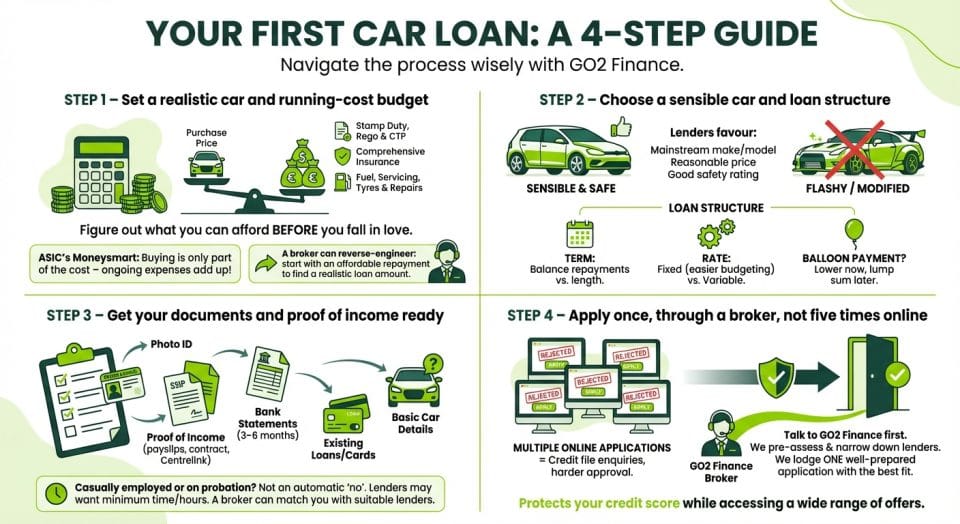
Step 1 – Set a realistic car and running-cost budget
Before you fall in love with a car on Marketplace, figure out what you can comfortably afford, including:
- Purchase price (or the portion you’re financing after any deposit/trade-in)
- Stamp duty, rego and CTP
- Comprehensive insurance (essential for financed cars)
- Fuel, servicing, tyres and repairs
ASIC’s Moneysmart resources emphasise that buying the car is only part of the cost – ongoing running expenses add up quickly and should be built into your budget.
A broker can help you reverse-engineer this: start with a repayment you can afford, then work back to a realistic loan amount and car price.
Step 2 – Choose a sensible car and loan structure
For a first car loan with no credit history, choosing something sensible and safe usually works better than going for a flashy performance car. Lenders tend to look more favourably on:
- Mainstream make and model
- Reasonable purchase price for your income
- Good safety rating and not heavily modified
Loan-wise, think about:
- A term that balances affordable repayments with not stretching the loan too long
- Fixed vs variable rate (fixed makes budgeting easier)
- Whether you’re comfortable with features like a balloon payment – which can make repayments cheaper now but leave a lump sum at the end
Step 3 – Get your documents and proof of income ready
Typical documents lenders may ask for include:
- Photo ID (licence, passport)
- Proof of income (recent payslips, employment contract, Centrelink statement if applicable)
- Bank statements (often 3–6 months)
- Details of any existing loans or credit cards
- Basic information about the car you’re planning to buy
If you’re casually employed or on probation, that doesn’t automatically mean “no”, but some lenders will want to see a minimum time in the role or consistent hours. A broker can help match you with lenders who are more comfortable with your employment type.
Step 4 – Apply once, through a broker, not five times online
Every full car loan application can leave an enquiry on your credit file. Too many in a short time can worry lenders and make approval harder.
Instead of firing off multiple online applications:
- Talk to a broker like GO2 Finance first.
- We’ll pre-assess your situation and narrow down lenders who are genuinely suitable.
- Then we’ll lodge one well-prepared application with the lender that’s the best fit.
This protects your credit score while still giving you access to a wide range of lenders and offers.
What lenders look at when you don’t have a credit score
When your credit history is thin, lenders lean heavily on other parts of your application.
Income, employment and stability
Lenders generally consider:
- Your gross and net income (after tax)
- How long you’ve been in your current job
- Whether you’re full-time, part-time, casual or an apprentice
- Your living arrangements (at home, renting, share house)
Younger borrowers, especially under 25, are often seen as higher risk because they have less work history and less financial track record. That’s why showing stability, even if it’s only been a few months is valuable.
Bank statements and spending patterns
With no credit history to look at, many lenders scrutinise your bank statements. They’ll look for:
- Regular income hitting your account
- Your typical everyday spending and bills
- Whether you regularly exceed your balance or use overdraft
- Existing loan or buy-now-pay-later repayments
Showing responsible money habits – paying bills on time, not constantly going into the red – can help offset a lack of credit history.
Deposit size, trade-ins and your car choice
A contribution from you (savings or a trade-in) lowers the lender’s risk. Even a small deposit can:
- Reduce how much you need to borrow
- Improve your chances of approval
- Potentially put you in a better position to negotiate terms
The car itself also matters: lenders are usually more comfortable with a reliable, mainstream car than a high-powered import or heavily modified vehicle.
Ways to boost your chances of approval (without risky shortcuts)
Saving a deposit and a small buffer
You don’t always have to have a deposit for a first car loan, but saving even 5–10% of the purchase price can make a big difference. It shows discipline and lowers the amount you need to borrow.
Try to also keep a small buffer in your account so your first few repayments don’t wipe you out.
Considering a guarantor or co-borrower
Some young buyers involve a parent or family member as a:
- Guarantor – they promise to step in if you can’t make repayments
- Co-borrower – their income and credit record are part of the application, and they’re jointly responsible for the loan
This can help in some scenarios, but it’s a serious commitment for the other person. If things go wrong, it can affect their credit history and relationship with you. Everyone should understand the risks and, ideally, get independent advice before signing.
At GO2 Finance, we can walk both of you through the pros and cons so nobody feels pressured.
Building credit gently before you apply
You don’t need to go out and grab a bunch of loans just to “build credit”. But sensible use of small products – like a phone plan in your own name or a low-limit card you pay off in full each month – can help establish a positive track record over time, if you use them carefully.
If you’re not confident you’ll manage it well, it can be safer to focus on building savings and keeping your bank statements clean instead.
Common traps first-time car buyers fall into
Dealer finance, ‘interest-free’ deals and add-ons
Car dealers often sell finance as part of the process. Sometimes the rate is competitive; other times it’s offset by:
- Higher car prices
- Mandatory add-on products (warranties, paint protection, insurance)
- Fees buried in the fine print
“0% interest” or “no repayments for 12 months” deals can be complex and may cost more overall once fees or inflated car prices are factored in. Consumer sites and Moneysmart regularly warn buyers to look beyond the headline offer and compare total cost.
Overcommitting on repayments in a cost-of-living squeeze
With rents, fuel and groceries all rising, it can be tempting to stretch yourself to get the car you really want. The risk is that even one life change – fewer shifts, moving out, starting uni – can turn a manageable repayment into a problem.
A good rule of thumb: your car repayment should still feel comfortable after you add realistic running costs and a bit of breathing room.
Hidden fees, balloon payments and early payout costs
Always watch for:
- Establishment or ongoing fees
- Balloon payments at the end of the term
- Break costs or early payout fees if you want to clear the loan early
A broker can help you understand the true cost of each option before you sign.
How GO2 Finance helps young Australians with their first car loan
Protecting your credit score while you shop around
At GO2 Finance, we know how easy it is for young borrowers to accidentally damage their credit score by applying with too many lenders at once. We help you avoid that by:
- Doing a full review of your situation before any application is lodged
- Using our panel of lenders to identify which ones are most likely to suit your profile
- Lodging a targeted application instead of “spray and pray” online
This strategy lets you compare options without scattering enquiries all over your credit report.
Matching lenders to your job, income and car
Different lenders have different appetites when it comes to:
- Young borrowers
- Apprentices, casual workers and probationary employees
- Private sale vs dealer purchase
- Older or higher-kilometre cars
Because we work with these lenders every day, we know who is more comfortable with your type of situation. That means:
- Better chances of approval
- Less time wasted chasing lenders who aren’t a fit
- Clearer expectations around documents and conditions
If you’re unsure where you stand, you can talk to Brent and the team about your scenario – no pressure, just straight answers.
Why choose GO2 Finance and Brent’s team
When you’re new to credit, having the right people in your corner matters. Here’s why many first-time buyers choose GO2 Finance:
- First-car and asset finance specialists – we regularly help P-platers, apprentices and young professionals into their first car loans.
- Access to a broad lender panel – including banks, non-bank lenders and specialist providers comfortable with thin credit files.
- Personalised scenarios, not generic advice – we look at your job, income, living situation and car choice to shape a strategy.
- Help with all the paperwork – from documents through to settlement, we keep the process clear and manageable.
- Credit-score friendly approach – we aim to minimise unnecessary credit enquiries and help you understand the long-term impacts of your decisions.
- Ongoing support – if you want to upgrade later or refinance, we’re here for the long haul, not just the first loan.
If you’re thinking about your first car loan with no credit history, a quick conversation with GO2 Finance can save you a lot of guesswork.
First car loan checklist: Are you ready to apply?
Before you hit “apply”, run through this quick checklist:
- I’m at least 18 and hold (or will shortly hold) a valid driver licence
- I’ve worked out a realistic total car budget, including insurance and running costs
- I have a steady income (job, apprenticeship or similar) and can show recent payslips or income statements
- My bank statements for the last few months don’t show constant negative balances or dishonors
- I’ve saved at least a small deposit or have a trade-in
- I’ve chosen a sensible car that lenders are likely to be comfortable with
- I understand the basics of interest, fees and how long the loan will run
- I’ve spoken to a broker like GO2 Finance, rather than applying with lots of lenders on my own
If you can tick most of these boxes, you’re in a good position to talk to GO2 Finance about the next steps. A quick online enquiry or short phone call can get the ball rolling on your first car loan.